AI writes code faster than anyone can understand it. Endure captures intent, detects drift, and surfaces what's silently rotting — before it becomes a crisis.
Linters catch syntax. Security scanners catch vulnerabilities. Tests catch regressions. Nothing catches the slow erosion of understanding — until a critical incident reveals it.
Every file was written for a reason. Those reasons live in Slack threads, PR descriptions, and the heads of people who left six months ago.
Each change made without understanding the original intent is a small bet against the future. Enough small bets compound into architectural collapse.
Complexity scores tell you what. Churn tells you where. Nothing tells you why something is becoming fragile or what it's supposed to be doing.
AI-generated code appears without the context that would have existed if a human wrote it slowly. Velocity without understanding is just faster forgetting.
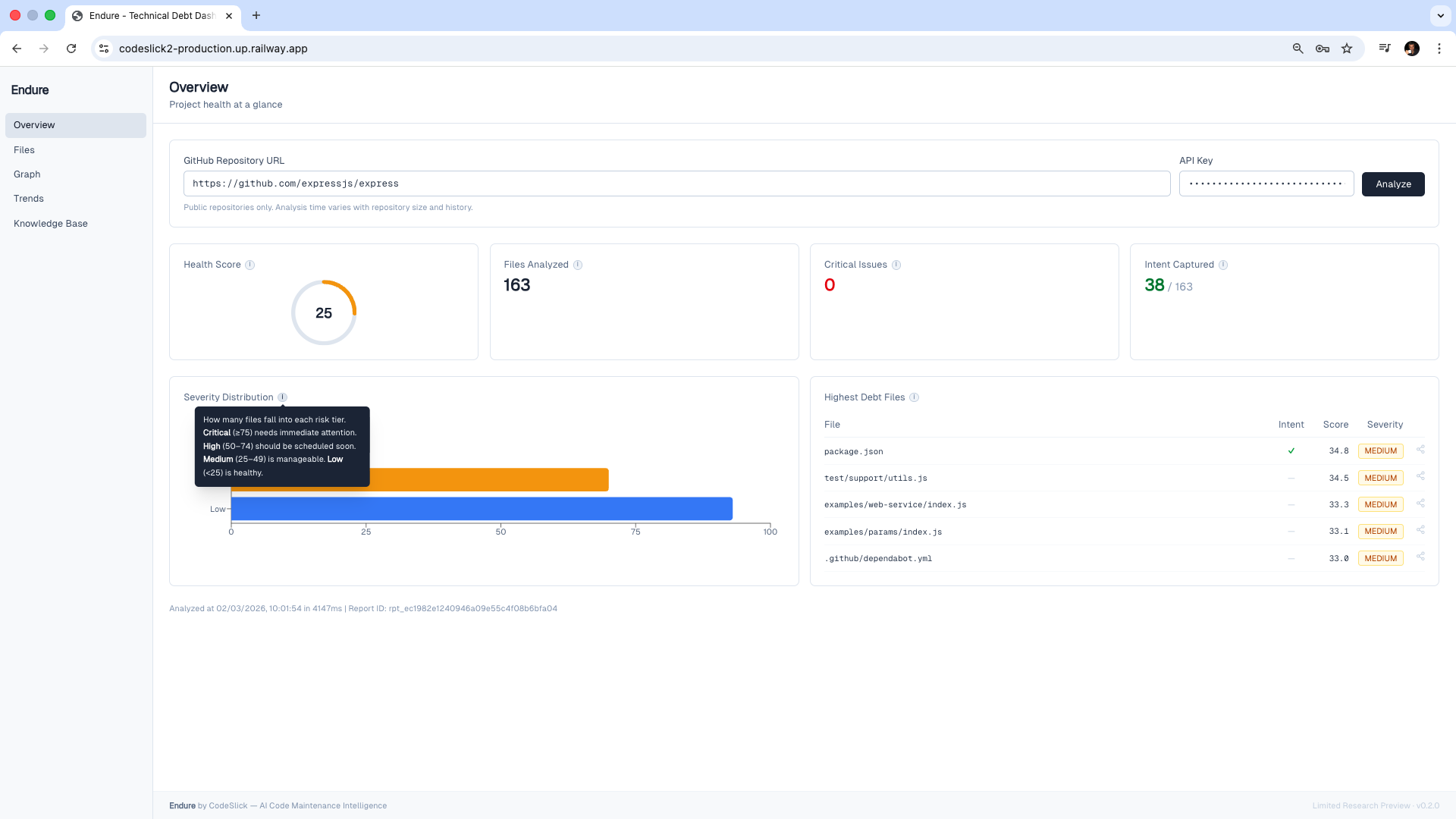
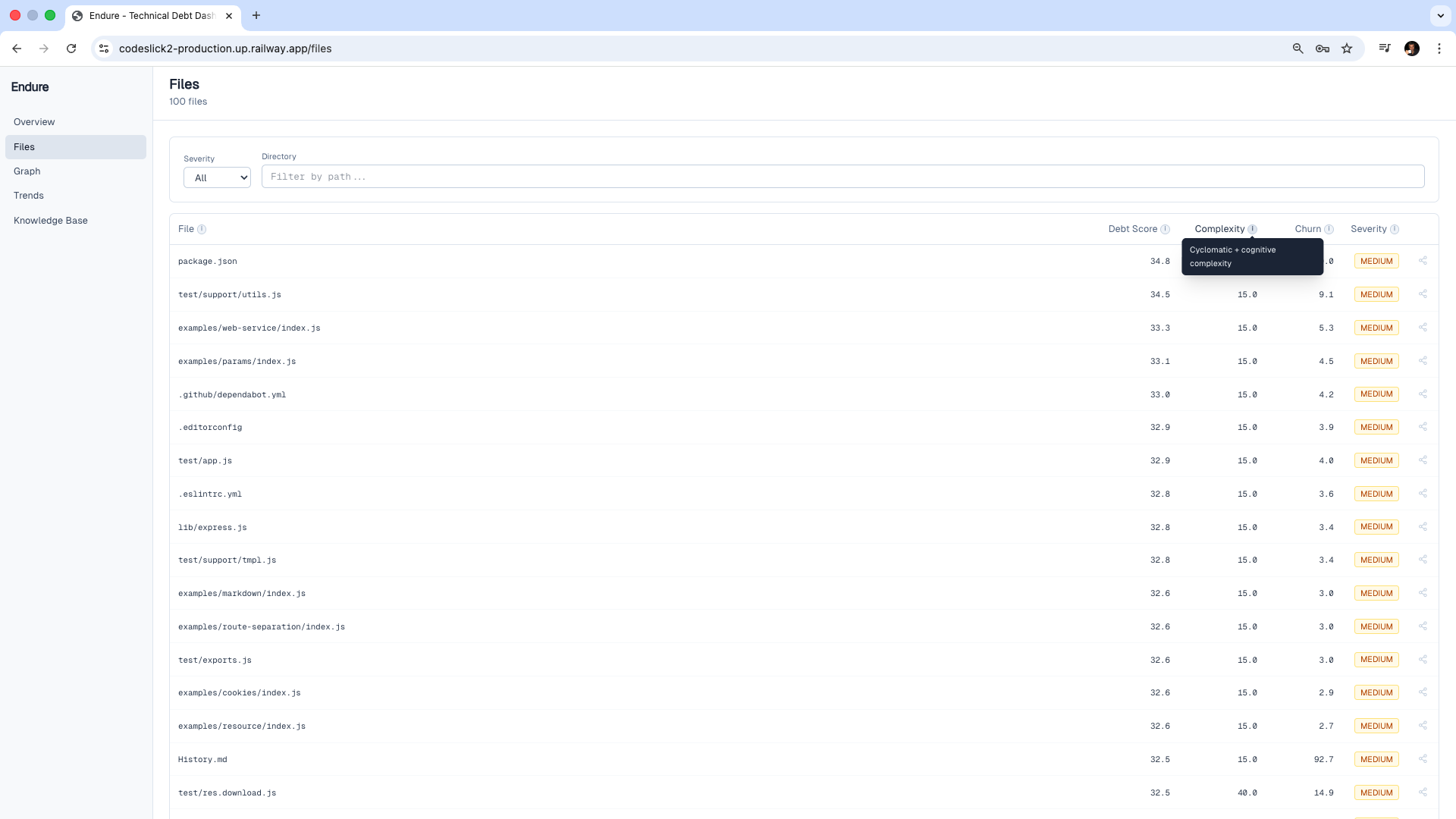
Endure analyzes every file — complexity, churn, staleness, duplication, and how much of its intent has been captured and understood.
Endure runs alongside your existing workflow — no new process, no mandatory annotations. It builds understanding progressively from what already exists.
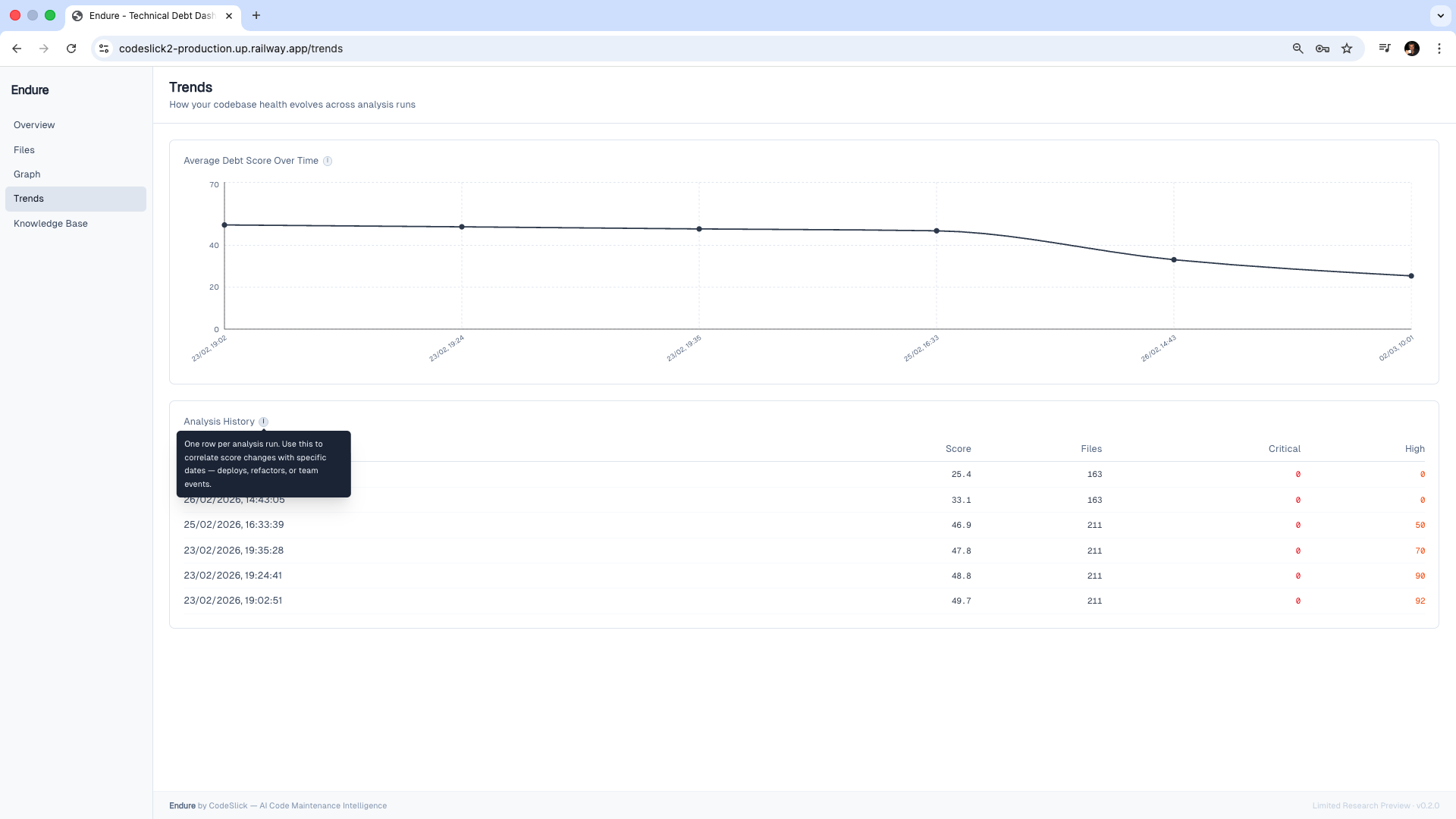
Point Endure at any git repository. It scores every file on five dimensions: complexity, churn, staleness, duplication, and intent coverage — weighted into a single Debt Score and a Software Understanding Score for the whole codebase.
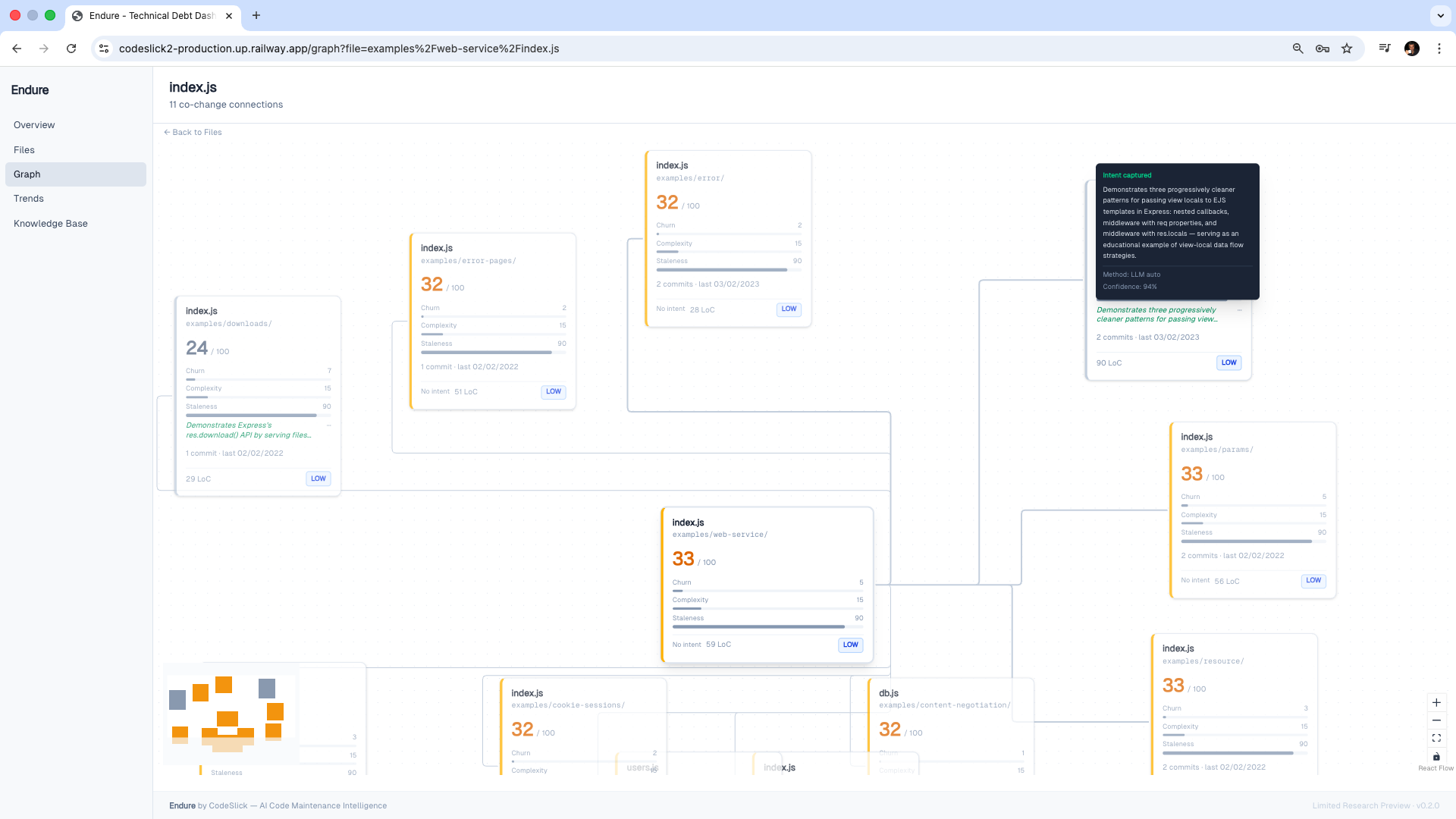
For high-debt files, Endure asks an LLM: what is this file supposed to do? The answer is self-judged for quality, stored in a database, and attached to future analysis runs. No manual annotation required. 93% average confidence on the first pass.
As your code evolves, Endure compares what a file is now doing against what it was supposed to do. Drift surfaces as a severity score — not a guess, but a structured comparison against the captured intent.
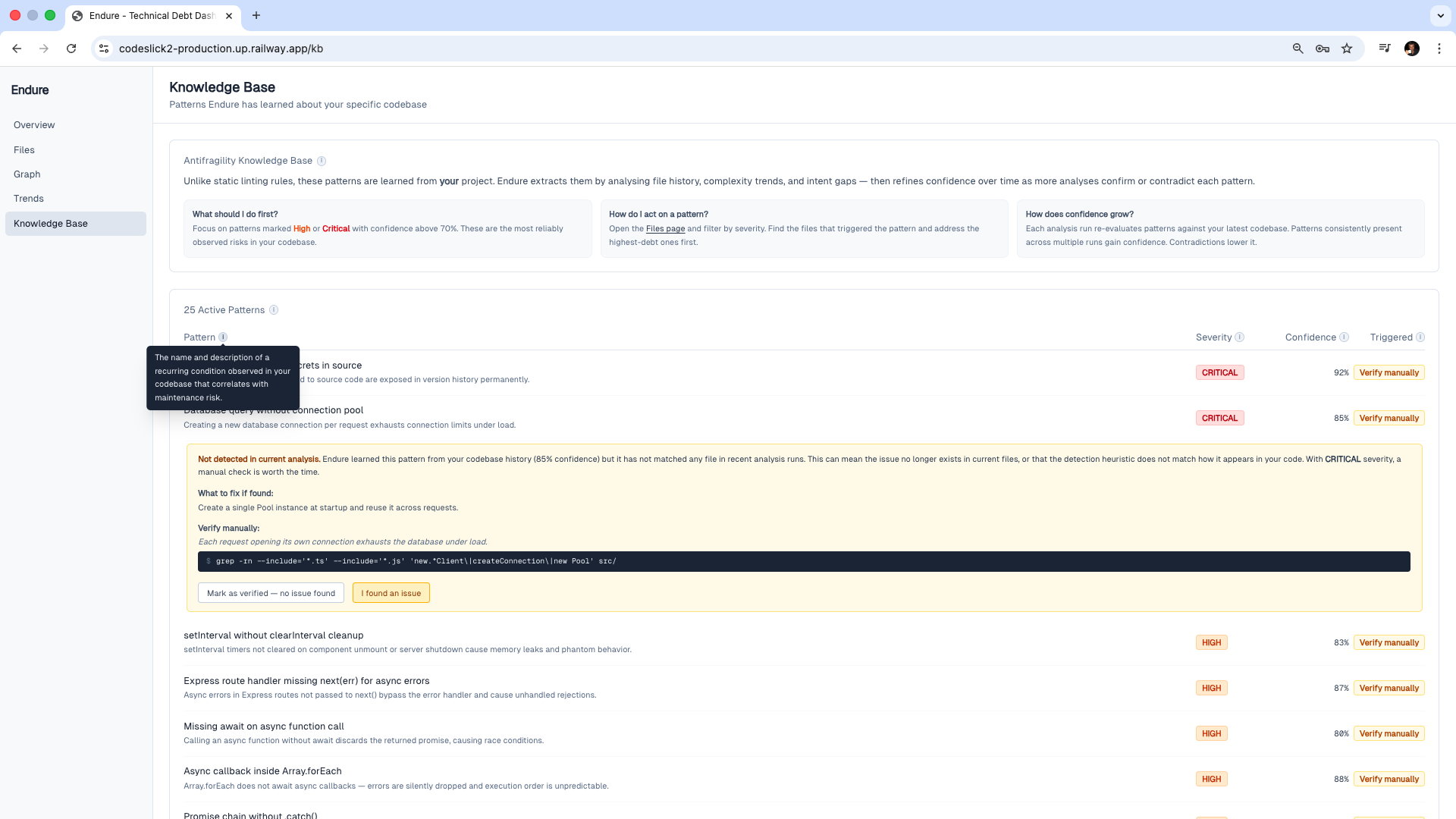
Every maintenance event is a signal. Endure's Knowledge Base extracts patterns from real incidents, validates them against your codebase, and surfaces the ones with high precision — so the next team doesn't make the same mistake.
Intent is the invariant; code is the implementation. Intent must outlive any single file or function and be versioned as rigorously as code.
Missing context causes maintenance failures, not compile failures. Context has a lifecycle: created, consumed, evolved, deprecated.
All systems drift from their original assumptions. Drift is not failure — blindness to drift is. Measurable drift enables corrective action.
Understanding cannot be reconstructed from code alone. It must be captured at creation time. It degrades without active preservation.
Systems should improve from maintenance stress. Each fix should reduce future failure probability. Learning must be structural, not just human.
Maintenance is not a cost — it's the product learning. Maintenance readiness is measurable. Maintenance velocity is optimizable.
"Code that passes all checks but fails maintainability is the most dangerous code in your system. It's invisible until it isn't."
We're onboarding a small number of design partners who care deeply about code maintainability. No cost during the preview. White-glove setup. Your feedback shapes the product.
No spam. No sales calls. Just a conversation about your codebase.